Marco Orlando

Marco Orlando

SMASH Postdoctoral Research Fellow, University of Nova Gorica

About Me

I am a Computational Biologist with extensive wet-lab expertise, working for over 8 years in the characterization of novel proteins/enzymes and studying structure-function interconnections during evolution. I specialize in integrating wet-lab and computational methods.

Currently, I am focusing on Protein Design, developing custom workflows that integrate AI- and physics-based methods to generate binders for folded and unfolded epitopes of medically relevant biomarkers.

Current Main Project

AI-Driven Design of CDKL5 Binders with Minimal Screening

I am developing a computational pipeline to design binders for studying the biology of challenging biomarkers like CDKL5 kinase, which is poorly immunogenic/druggable, as different isoforms and closely related paralogue kinases exist. In this project we need to target specific epitopes, both in folded and unfolded regions, and find binders that, prior to have great affinity, are also specific and developable for cell-based studies.

The key challenge to address is achieving both binding and developability success while keep the experimental screening at minimum (<20 characterized designs). This will be done by efficiently leveraging multiple AI-based and physics-based agents to filter out and optimize several thousands of epitope-specific candidates. This will allow to bypass the severe high-throughput experimental bottleneck that exists for making reagents suitable to target functional regions of this biomarker in cell studies.
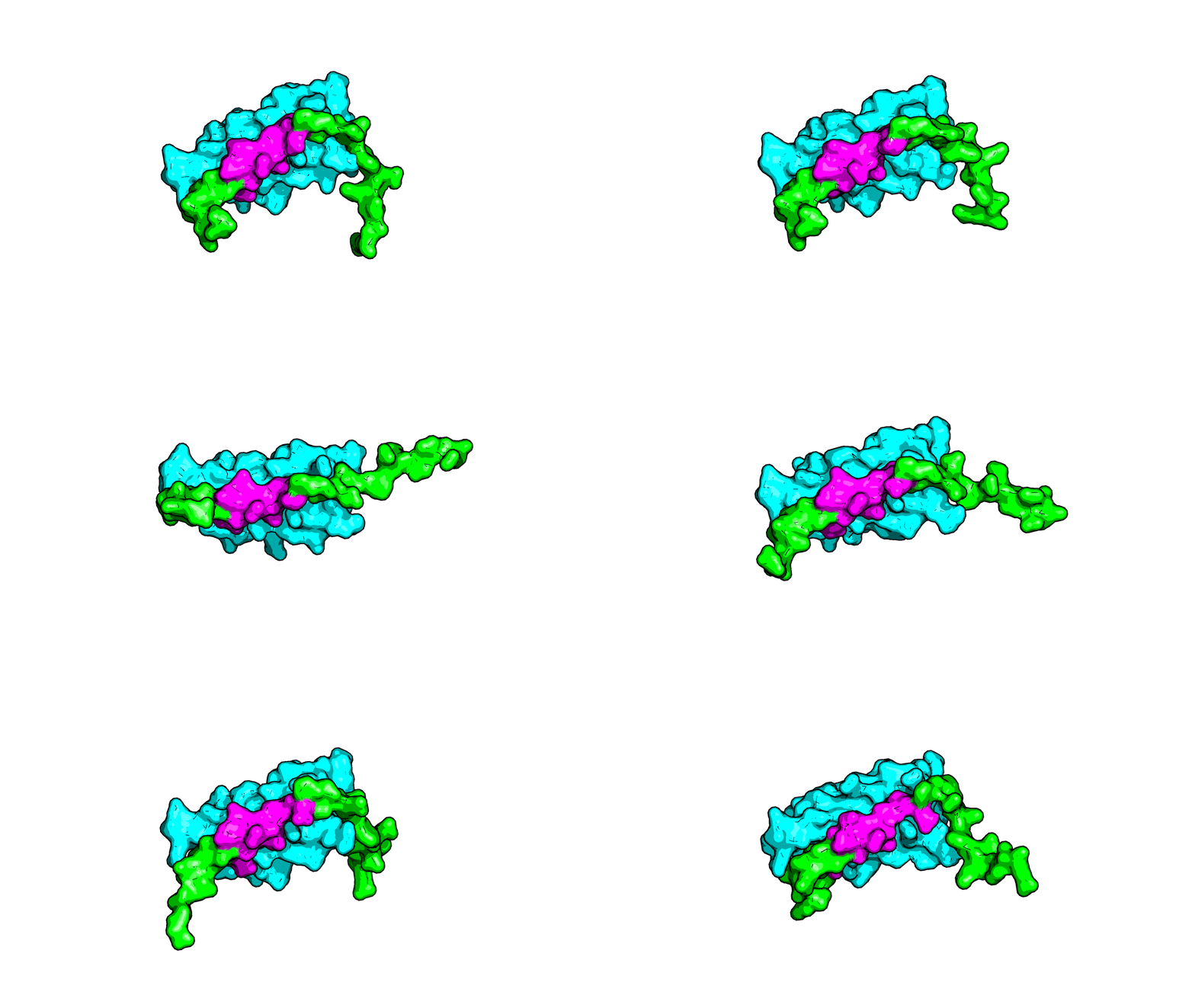
Design workflow

Skills & Expertise

Bioinformatics & Computational

Protein Function Annotation Structural Biology Molecular Dynamics Binding Free Energy Conformational Analysis
Phylogenetics Ancestral Reconstruction AI Protein Design Physics-based Design

Tools & Languages

Python Bash Linux Jupyter
Plotly Colab Antigravity

Laboratory Skills

Protein Expression & Purification Enzyme Kinetics Biophysical Analysis (CD/Fluoro) Microbial Cell Culture Mutagenic PCR Plasmid Design

Featured Repositories

Loading...

Selected Publications

Protein Design & Structural Biology

An integrative structural biology approach to identify the binding mode of a nanobody towards the pea ascorbate peroxidase
C D’Ercole, M Orlando, KE Filipič, A De Marco • Computational and Structural Biotechnology Journal
A crucial active site network of titratable residues guides catalysis and NAD+ binding in human succinic semialdehyde dehydrogenase
S Cesaro, M Orlando, et al. • Protein Science
Biochemical and cellular studies of three human 3‐phosphoglycerate dehydrogenase variants responsible for pathological reduced L‐serine levels
G Murtas, E Zerbini, et al. • Biofactors
On the quaternary structure of human D‐3‐phosphoglycerate dehydrogenase
D Riva, M Orlando, V Rabattoni, L Pollegioni • Protein Science
The co‐existence of cold activity and thermal stability in an Antarctic GH42 β‐galactosidase relies on its hexameric quaternary arrangement
M Mangiagalli, M Lapi, et al. • The FEBS Journal
An anti-HER2 nanobody binds to its antigen HER2 via two independent paratopes
D Ubbiali, M Orlando, et al. • International journal of biological macromolecules
CDR1 composition can affect nanobody recombinant expression yields
M Orlando, S Fortuna, et al. • Biomolecules

Enzymes for Plastic Degradation & Circular Economy

Valorization of organic waste through black soldier fly: On the way of a real circular bioeconomy process
D Bruno, M Orlando, et al. • Waste Management
Electroconductive bionanocomposites from black soldier fly proteins for green flexible electronics
E Testa, M Orlando, et al. • ACS Sustainable Chemistry & Engineering
Plastic-degrading microbial consortia from a wastewater treatment plant
A Salini, M Orlando, et al. • Int. J. Mol. Sci.
Microbial enzyme biotechnology to reach plastic waste circularity: current status, problems and perspectives
M Orlando, G Molla, et al. • Int. J. Mol. Sci.
Efficient polyethylene terephthalate degradation at moderate temperature: a protein engineering study...
V Pirillo, M Orlando, et al. • The FEBS Journal

Carbohydrate-Active Enzymes & Extremophiles

Polysaccharide degradation in an Antarctic bacterium: Discovery of glycoside hydrolases...
M Orlando, A Marchetti, et al. • Int. J. Biol. Macromolecules
Xylan Degradation in the Halotolerant Bacterium Bacillus altitudinis relies on glycosidic hydrolases...
A Marchetti, M Orlando, et al. • J. Agric. Food Chem.
Evolutionary history and activity towards oligosaccharides... of GH3 glycosidases
A Marchetti, M Orlando, et al. • Int. J. Biol. Macromolecules
The GH19 Engineering Database: Sequence diversity, substrate scope, and evolution...
M Orlando, M Lotti, J Pleiss • PLoS One
The “cold revolution”. Present and future applications of cold-active enzymes...
M Mangiagalli, M Orlando, et al. • New biotechnology

Phylogenetics & Biodiversity

Towards elucidating species diversity of European inland Strigamia...
L Bonato, M Orlando, et al. • Zoological Journal of the Linnean Society
New insights into Plutonium, one of the largest and least known European centipedes...
L Bonato, M Orlando, et al. • Zoological Journal of the Linnean Society

Get in Touch

Wave

Happy to get in contact for scientific collaborations, seminars, and any opportunity in the protein evolution, discovery, and design field.
Feel free to reach out via Email or connect on social platforms!